8 mm rebar weight
0.395 kg/m · 0.265 lb/ft
8 mm rebar has a nominal diameter of 8 mm and a cross-sectional area of 50.3 mm².
Lightest bar allowed by IS 1786: 0.363 kg/m (−8 %), so a 12 m bar must weigh at least 4.36 kg. Weight tolerance
Also called: T8 or H8 (UK) · 8 mm TMT bar or sariya (India).
8 mm rebar weight calculator
Weight of standard bar lengths
| Bars | 6 m (kg) | 12 m (kg) |
|---|---|---|
| 1 | 2.4 | 4.7 |
| 10 | 23.7 | 47.4 |
| 50 | 118.5 | 237.0 |
| 100 | 237.0 | 474.0 |
Bars per tonne
| Bar length | Bars per tonne |
|---|---|
| 6 m | 421.9 |
| 9 m | 281.3 |
| 12 m | 211.0 |
One tonne of 8 mm rebar is 2,532 m per tonne. Use this to turn a weight on a delivery note into a bar count.
8 mm TMT bar in India (IS 1786)
Fe 415, Fe 500, Fe 500D, Fe 550D and Fe 600 bars of 8 mm all have the same nominal mass in IS 1786 Table 1: 0.395 kg/m. A 12 m bar weighs 4.74 kg, 100 bars weigh 474 kg, and a tonne is about 211 bars. TMT is priced per kg or per tonne, so the brand and grade change the price per kg, not the weight of a bar.
8 mm rebar area: diameter, mm² and in²
8 mm rebar is 8 mm (0.315 in) in diameter with a nominal area of 50.3 mm² (0.078 in²). For a design check, the steel area of a group of bars is the bar area times the number of bars:
| Number of bars | Area (mm²) | Area (in²) |
|---|---|---|
| 1 | 50 | 0.08 |
| 2 | 101 | 0.16 |
| 3 | 151 | 0.23 |
| 4 | 201 | 0.31 |
| 5 | 252 | 0.39 |
| 6 | 302 | 0.47 |
| 8 | 402 | 0.62 |
| 10 | 503 | 0.78 |
In slabs and walls the steel is given per metre of width: area per metre = bar area × 1000 ÷ spacing in mm.
| Spacing (centres) | mm²/m | in²/ft |
|---|---|---|
| 100 mm | 503 | 0.238 |
| 125 mm | 402 | 0.190 |
| 150 mm | 335 | 0.158 |
| 200 mm | 252 | 0.119 |
| 250 mm | 201 | 0.095 |
| 300 mm | 168 | 0.079 |
How the weight is calculated
Area = π ÷ 4 × 8² = 50.3 mm². Weight per metre = area × 7850 kg/m³ = 50.3 × 10⁻⁶ m² × 7850 = 0.395 kg/m. The d² ÷ 162 rule gives 64 ÷ 162 = 0.395 kg/m.
Deformed bars and TMT bars are sold by nominal diameter and nominal mass; the ribs are already allowed for, and standards accept a small mass tolerance per bar. See the rebar weight formula guide.
8 mm rebar weight tolerance: lightest bar allowed
IS 1786:2008 (Table 2) puts 8 mm bars in the band up to and including 10 mm. Thin bars get the widest allowance. One bar may weigh up to 8 % less than the nominal 0.395 kg/m, with no limit above; the average of a batch must stay within ±7 %.
| kg/m | 6 m bar (kg) | 12 m bar (kg) | |
|---|---|---|---|
| Nominal | 0.395 | 2.37 | 4.74 |
| Lightest single bar (−8 %) | 0.363 | 2.18 | 4.36 |
| Batch average, lowest (−7 %) | 0.367 | 2.20 | 4.41 |
| Batch average, highest (+7 %) | 0.423 | 2.54 | 5.07 |
To check a delivery, cut a piece at least 0.5 m long, weigh it and divide by its length (IS 1786 clause 7.2.3.1); below 0.363 kg/m the bar fails. Weighing whole bars works too, but a 12 m bar may be cut up to 25 mm short (clause 7.1), so the lowest acceptable full bar is 4.35 kg. 8 % of mass is only 4.1 % of diameter, because mass goes with the diameter squared: at the limit, the bar carries the steel of a plain bar of 7.67 mm, 46.3 mm² instead of 50.3 mm². Bought by weight, a tonne at the limit is 2,752 m of bar instead of 2,532 m: more metres, less steel in each.
8 mm rebar per square metre of slab
Weight of 8 mm rebar in a slab or wall for common spacings, for one layer in one direction and for bars both ways. Add laps, hooks and chairs on top.
| Spacing (centres) | One direction (kg/m²) | Both directions (kg/m²) |
|---|---|---|
| 100 mm | 3.95 | 7.90 |
| 125 mm | 3.16 | 6.32 |
| 150 mm | 2.63 | 5.27 |
| 200 mm | 1.98 | 3.95 |
| 250 mm | 1.58 | 3.16 |
| 300 mm | 1.32 | 2.63 |
Compared with nearby sizes
| Bar | kg/m | lb/ft | vs this bar |
|---|---|---|---|
| 6 mm rebar | 0.222 | 0.149 | −44 % |
| 8 mm rebar | 0.395 | 0.265 | — |
| 10 mm rebar | 0.617 | 0.415 | +56 % |
| 12 mm rebar | 0.888 | 0.597 | +125 % |
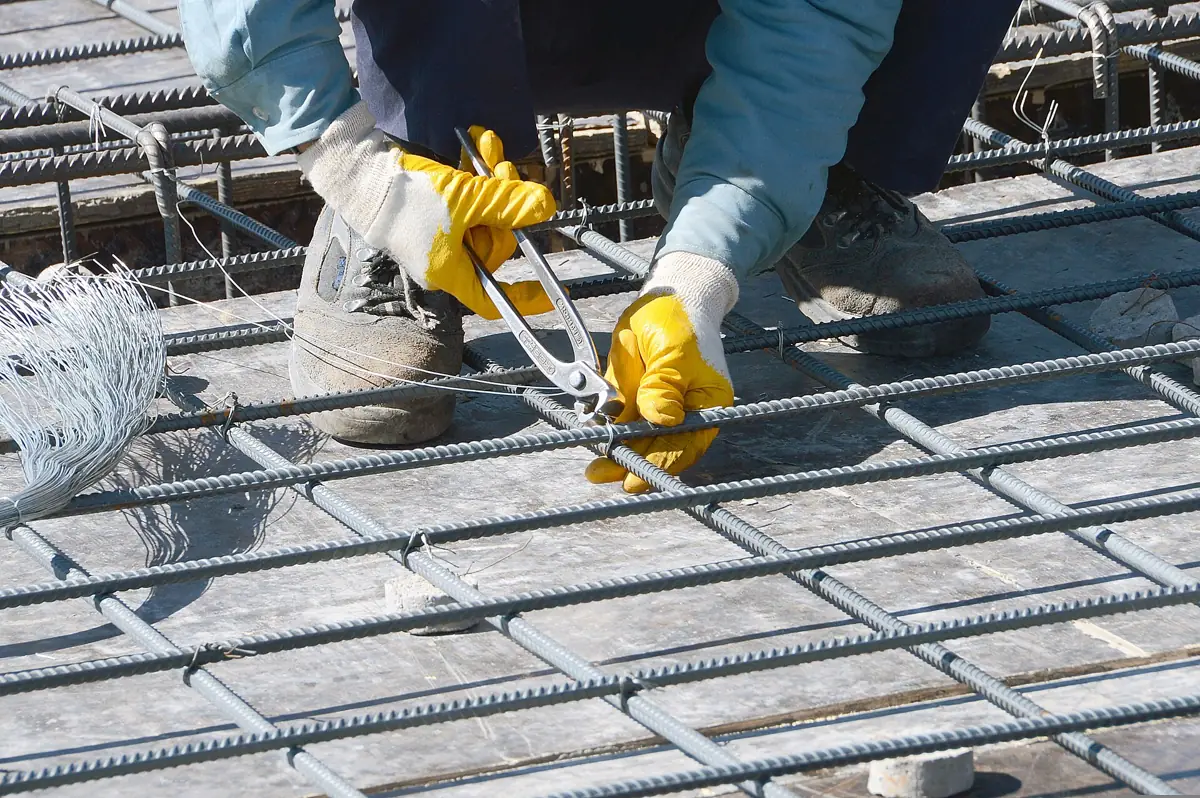
Bars this small are used mainly for stirrups, ties and links, and for light mesh in thin slabs and walls. The nearest US bar is #3 rebar (9.5 mm, 0.560 kg/m).
Frequently asked questions
What is the weight of 8 mm rebar per metre?
8 mm rebar weighs 0.395 kg/m (0.265 lb/ft). By the rule of thumb d squared over 162: 8 x 8 / 162 = 0.395 kg/m.
How much does a 12 m bar of 8 mm rebar weigh?
4.74 kg (0.395 kg/m × 12 m). A 6 m bar weighs 2.37 kg.
How many 12 m bars of 8 mm rebar are in a tonne?
About 211.0 bars, or 2,532 m per tonne.
What is the US equivalent of 8 mm rebar?
The nearest US bar is #3 rebar (9.5 mm, 0.560 kg/m). Check the steel area in the design before substituting one for the other.
How is the weight of 8 mm rebar calculated?
Area = π ÷ 4 × 8² = 50.3 mm². Weight per metre = area × 7850 kg/m³ = 50.3 × 10⁻⁶ m² × 7850 = 0.395 kg/m. The d² ÷ 162 rule gives 64 ÷ 162 = 0.395 kg/m.
How much 8 mm rebar is needed per square metre at 150 mm spacing?
One layer at 150 mm centres needs 2.63 kg/m² in one direction, 5.27 kg/m² for bars both ways, plus laps.
What is the area of 8 mm rebar in mm² and in²?
8 mm rebar has a nominal area of 50.3 mm², which is 0.078 in² (1 in² = 645.16 mm²). Its diameter is 8 mm or 0.315 in. Four bars give 201 mm² (0.31 in²).
What is the minimum weight of 8 mm rebar allowed by IS 1786?
IS 1786 Table 2 allows a single 8 mm bar to be up to 8 % under the nominal 0.395 kg/m, so the minimum is 0.363 kg/m, or 4.36 kg for a 12 m bar. A batch must average within ±7 %: 0.367 to 0.423 kg/m.
Does Fe 500D 8 mm TMT bar weigh more than Fe 500 or Fe 550D?
No. IS 1786 Table 1 gives one nominal mass per size for every grade (Fe 415, Fe 500, Fe 500D, Fe 550D, Fe 600): 0.395 kg/m for 8 mm, so a 12 m bar weighs 4.74 kg whatever the grade or brand. The grade only changes the strength and ductility.
What is H8 (or T8) rebar?
H8 is a 8 mm high-yield deformed bar to BS 4449 grade B500, as written on UK bar schedules (BS 8666); older drawings call it T8. It weighs 0.395 kg/m (BS 4449 Table 7), 4.74 kg per 12 m bar, and the mass per metre may differ from that by up to ±6 %.
Other bar sizes
6 mm rebar · 10 mm rebar · 12 mm rebar · 14 mm rebar · 16 mm rebar · 20 mm rebar · 25 mm rebar · 28 mm rebar · 32 mm rebar · 40 mm rebar · 50 mm rebar
Full rebar weight chart · Steel weight calculator
Data adapted from Wikipedia, "Rebar" (CC BY-SA 4.0). Mass tolerance: IS 1786:2008 Table 2 and clauses 7.1, 7.2. IS 1786:2008 Table 1 (nominal mass). UK: BS 4449:2005+A2:2009 Table 7.